The Sopwith Camel was a WWI single seat biplane fighter introduced by the British in 1917. Nicknamed “The Pilot Killer”, it was notoriously difficult to fly due its weight distribution and the gyroscopic effect of the nine-cylinder Clerget 9B rotary engine. However, those pilots who were able to control it made it the most lethal fighter in the war with 1,294 victories over enemy aircraft.
I've been learning to use Blender to build 3D computer graphics models since August 2013 and I decided to create this blog as a progress report and a portfolio.
Tuesday, 25 January 2022
Sopwith Camel F.1
Monday, 10 January 2022
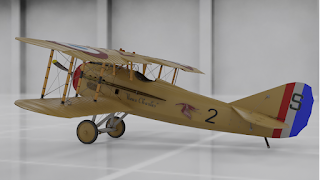
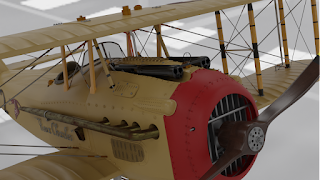
SPAD S.XIII
The SPAD S.XIII was a World War I single seat biplane fighter and successor to the SPAD S.VII. The plane was designed by Louis Béchereau of the Société pour l'aviation et ses derives (SPAD) and had its first flight in April 1917. 8,472 of the planes were built for the French Armée de l'Air, the British Royal Flying Corps and the U.S. Army Air Service.
The plane with a wingspan of 8.53 m (28 ft) was powered by a Hispano-Suiza water cooled V-8, 200 HP engine. Its top speed was 190 km/h (120 mph) at an altitude of 5,000 m (16,000 ft.) The armament consisted of two Vickers .303 machine guns mounted above the engine and synchronized to fire through the propeller at a rate of 500 rounds per minute.
This model carries the markings of the plane flown by the French ace, Capitaine Georges Guynemer who was credited with 54 victories during the war. He was pronounced missing in action (presumed shot down) during a mission over Southern Belgium on 11 September, 1917.
#SPAD #XIII #WWI #World_War_1 #airplane #Fighter #Blender #Cycles
Friday, 24 December 2021
Ford Model T Ambulance
“During World War I, the Allies used thousands of Model T cars and trucks because of their low cost and ease of repair. The ambulance version's light weight made it well-suited for use on the muddy and shell-torn roads in forward combat areas. If stuck in a hole, a group of soldiers could lift one without much difficulty. By Nov. 1, 1918, 4,362 Model T ambulances had been shipped overseas.
The light wooden body was mounted on a standard
Model T auto chassis. The 4-cylinder engine produced about 20 hp. There was no
self-starter; the engine had to be cranked by hand. This vehicle was equipped
with an early form of automatic transmission and could carry three litters or
four seated patients and two more could sit with the driver. Canvas
"pockets" covered the litter handles that stuck out beyond the
tailgate. Many American field service and Red Cross volunteer drivers,
including writers Ernest Hemingway and Bret Harte and cartoonist Walt Disney
drove Model T ambulances.
"Hunka Tin," a poem written as a parody
on Rudyard Kipling's "Gunga Din," appeared in the American Field
Service Bulletin and was used in Ford dealers' advertising throughout the
United States. The final stanza read:
Yes, Tin, Tin,
Tin.
You
exasperating puzzle, Hunka Tin.
I've abused
you and I've flayed you,
But by Henry
Ford who made you,
You are better
than a Packard, Hunka Tin.”
Thursday, 9 December 2021
Casualty Transportation
Here’s another configuration of the ubiquitous Berliet CBA; a WW1 ambulance.
Thursday, 2 December 2021
State-of-the Art Combat Communications
The Berliet CBA truck was manufactured from 1913 to 1938 by Automobiles M. Berliet SA. During that period 40,000 of the trucks were made and sold primarily to the French army. During WWI it had an in-line 5.3L engine burning petrol (gasoline). Its top speed was 25 km/h (15.5 mph.) In various configurations the trucks carried troops, supplies and ammunition to the front lines. It could also be configured as an ambulance or a mobile pigeon coop for combat communications.
This model Is imagined as it might have looked in December, 1914 in Northern France.
joyeux Noël !
#Berliet #truck #World_War_I #pigeons #Blender #Cycles
Tuesday, 16 November 2021
Japanese Kabuto
The Samurai kabuto (helmet) took many forms over the centuries, but the general shape and construction was fairly consistent. This model is based on the Suji Bashi style from the Muromachi period (1336 to 1573.) These helmets were typically elaborately decorated, especially on the detachable front ornament; in this example a stylized moth. The crown is made of 26 ridged iron plates riveted together and lacquered.
#Japanes
#Samurai #Kabuto #helmet #Blender #Cycles
Sunday, 7 November 2021
Roman Imperial Helmet
This model is based on the Niedermörmter helmet, described by Wikipedia:
“The Niedermörmter helmet, classified by Robinson as Imperial Italic H, is one of the best-preserved Roman Imperial helmets to have survived from antiquity. Made of bronze (an iron version reportedly resides in a private collection), the helmet is heavily decorated and has a neck guard which is far deeper than usual. The cross bracing across the skull is actually embossed, rather than applied, and there is a rather unusual dome-shaped knob where the braces meet at the crown of the head. This helmet is typically dated to the late Antonine or Severan eras, c. AD 180–235, but the find context of the helmet is unknown and the dating is based solely on its typology (i.e. it looks about 40–60 years down the evolutionary trail from the Italic G).” (Wikipedia)